Author Archives: Jane Booth

Leslie Baker Island Palette, CAPE COD HOME

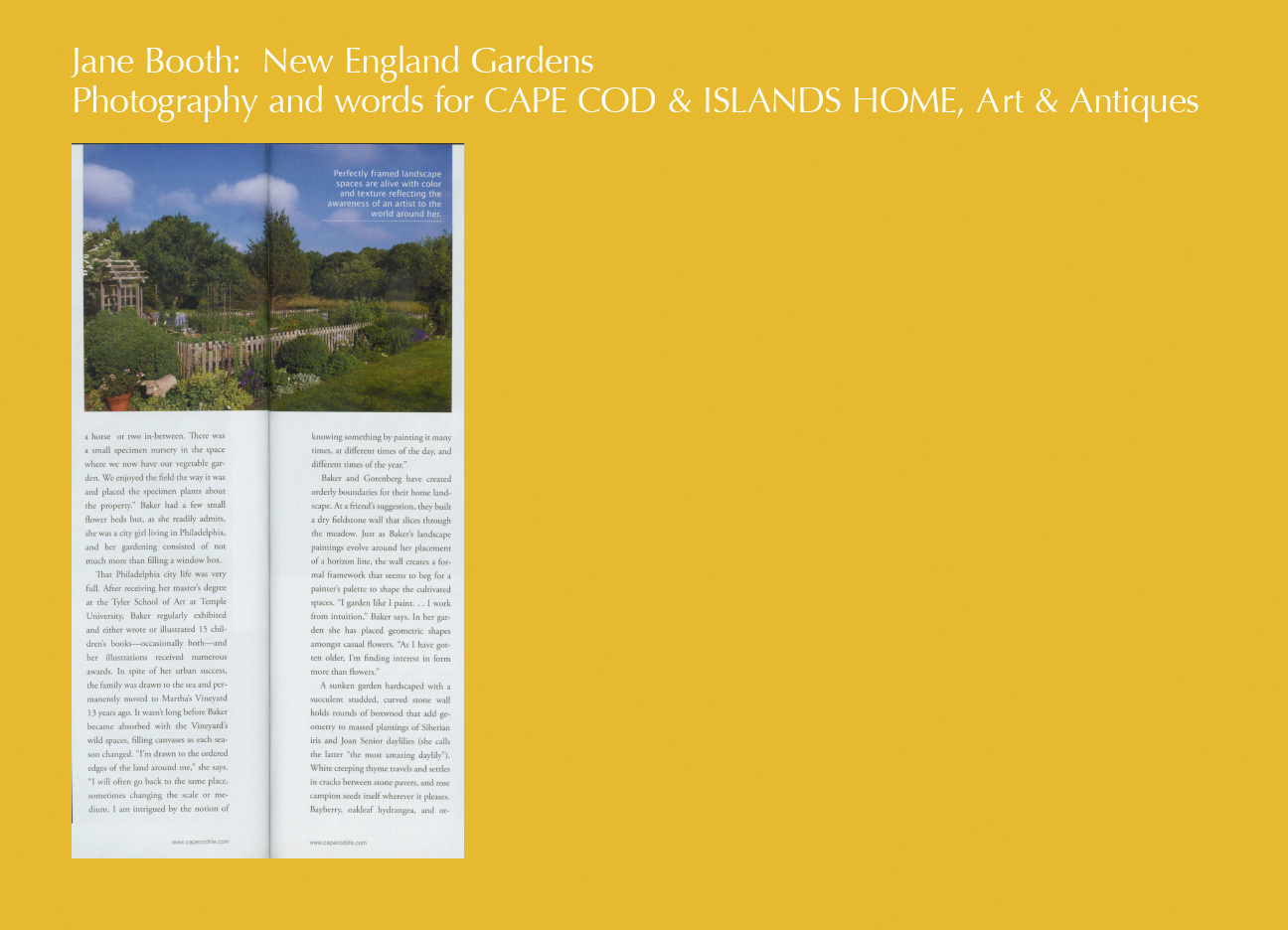
Oxeye daisies, perennial sweet peas, and dogs dogs dogs greet me when I arrive at the West Tisbury home of artist, Leslie Baker and her husband, Dr. David Gorenberg.

Oxeye daisies, perennial sweet peas, and dogs dogs dogs greet me when I arrive at the West Tisbury home of artist, Leslie Baker and her husband, Dr. David Gorenberg.

Leslie and David have created ordered edges in the home landscape.  At a friend’s suggestion they built a dry field stone wall.  It slices through the meadow delineating wild places from kept spaces.  Just as Leslie’s landscape paintings evolve around her placement of a horizon line, the wall allows for the same formal framework waiting for a painter’s palette to shape the kept spaces.

Leslie and David have created ordered edges in the home landscape. At a friend’s suggestion they built a dry field stone wall. It slices through the meadow delineating wild places from kept spaces. Just as Leslie’s landscape paintings evolve around her placement of a horizon line, the wall allows for the same formal framework waiting for a painter’s palette to shape the kept spaces.

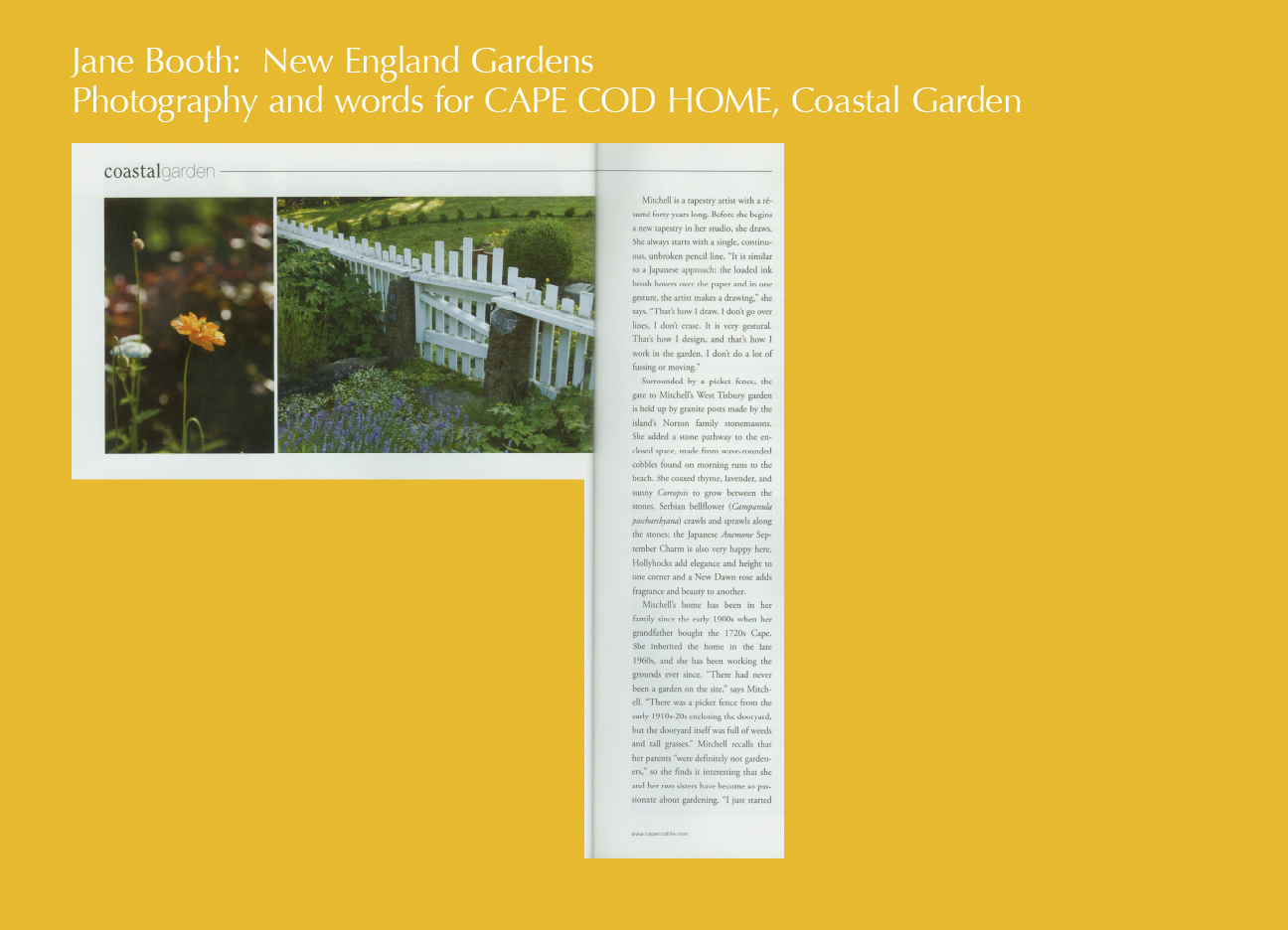
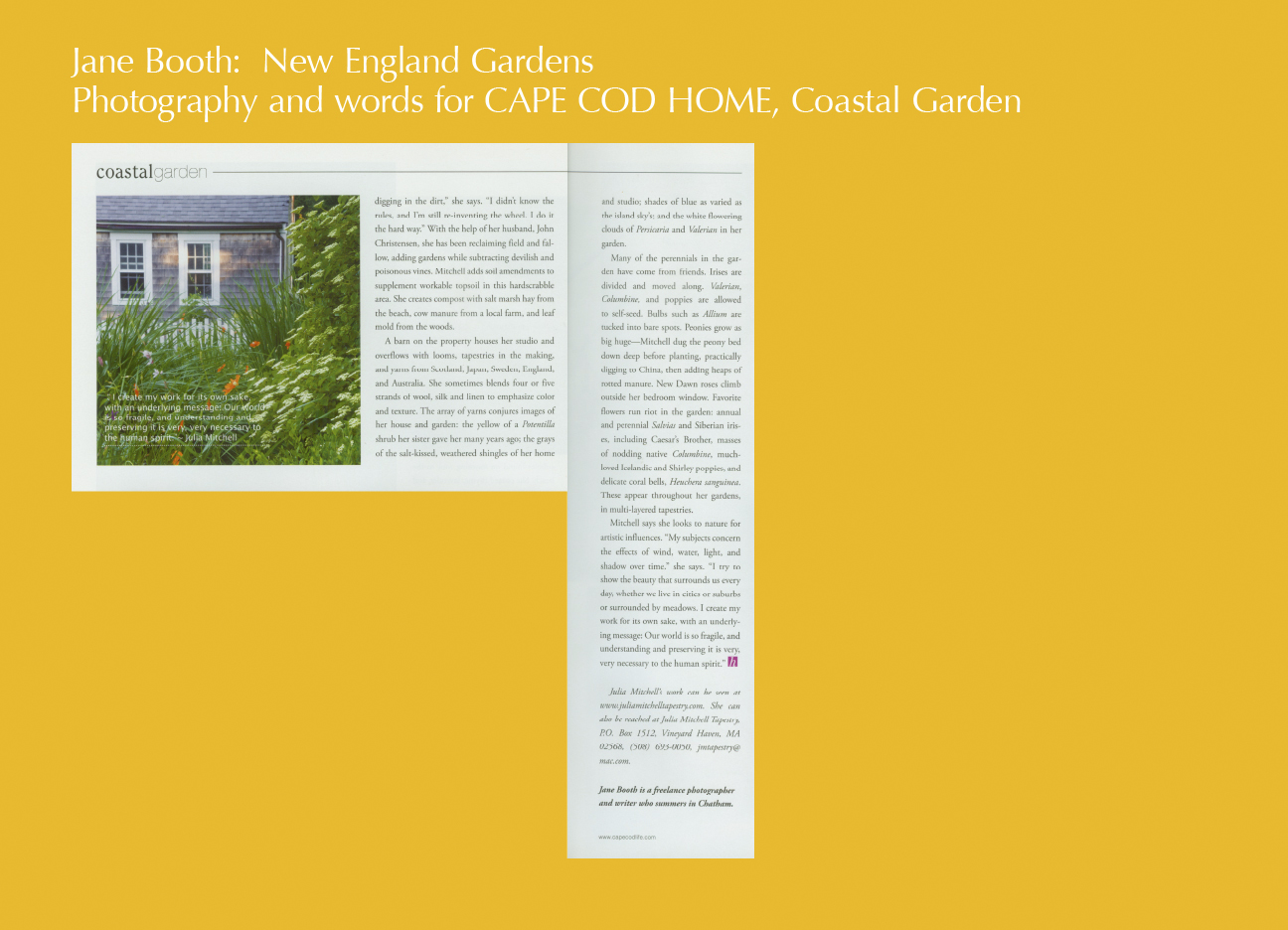
A Living Tapestry, CAPE COD HOME

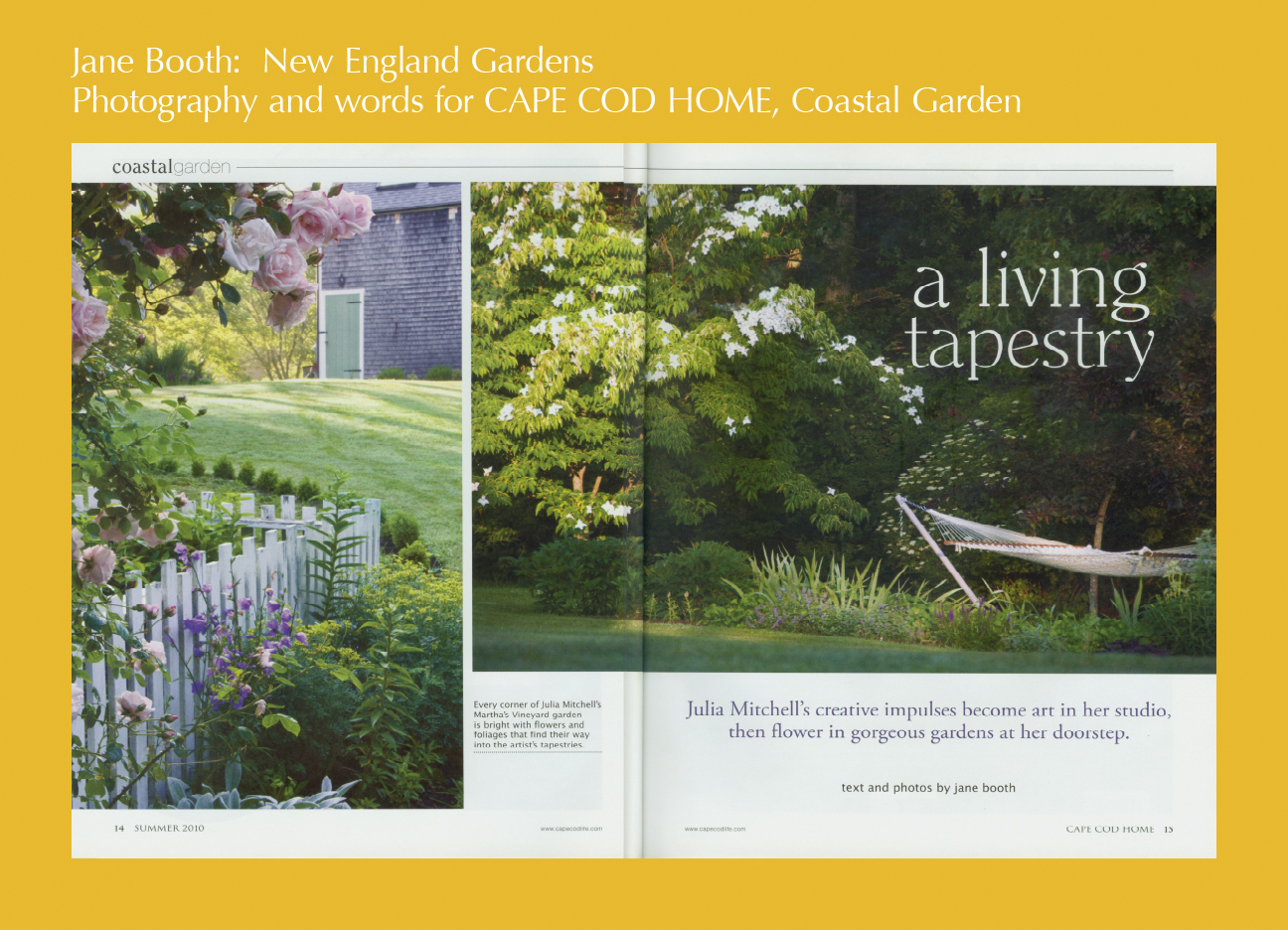
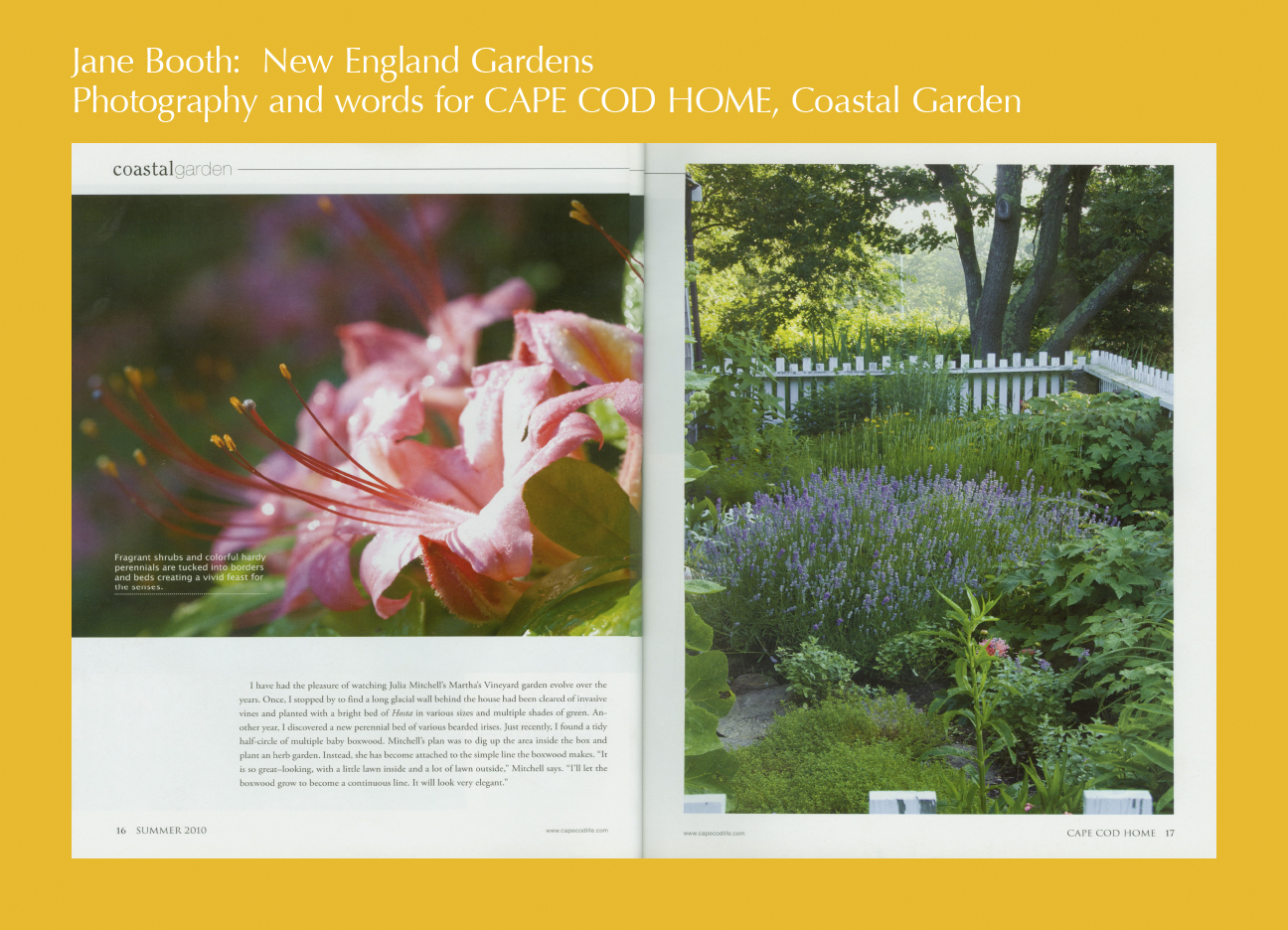
Julia Mitchell might be known for her fine tapestries but she also excels as a self taught gardener

Julia Mitchell might be known for her fine tapestries but she also excels as a self taught gardener.

You can find Julia Mitchells tapestries on the web, www.juliamitchelltapestry.com

You can find Julia Mitchells tapestries on the web, http://www.juliamitchelltapestry.com

CCH Julia Mitchell3

CCH Julia Mitchell4

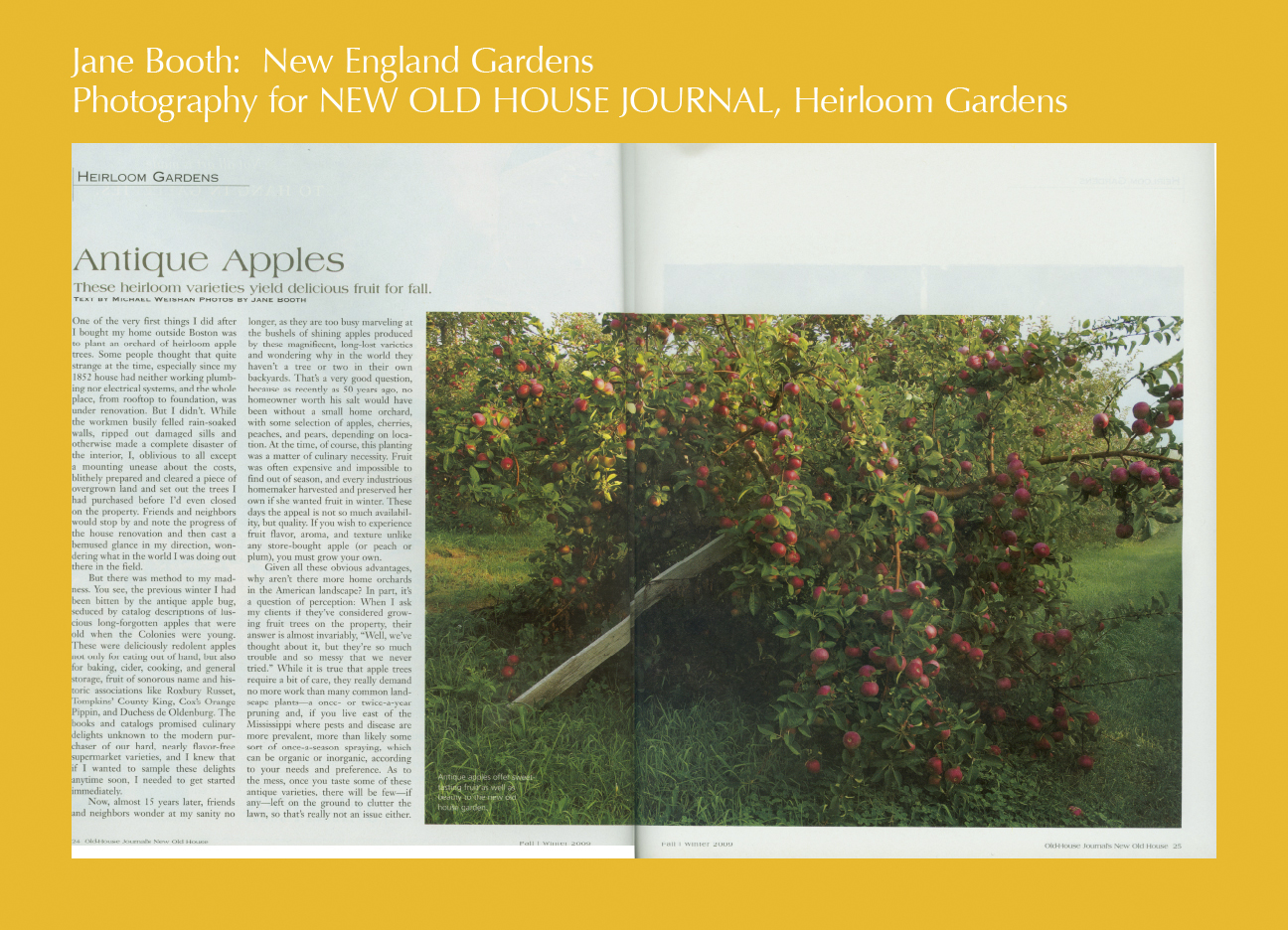
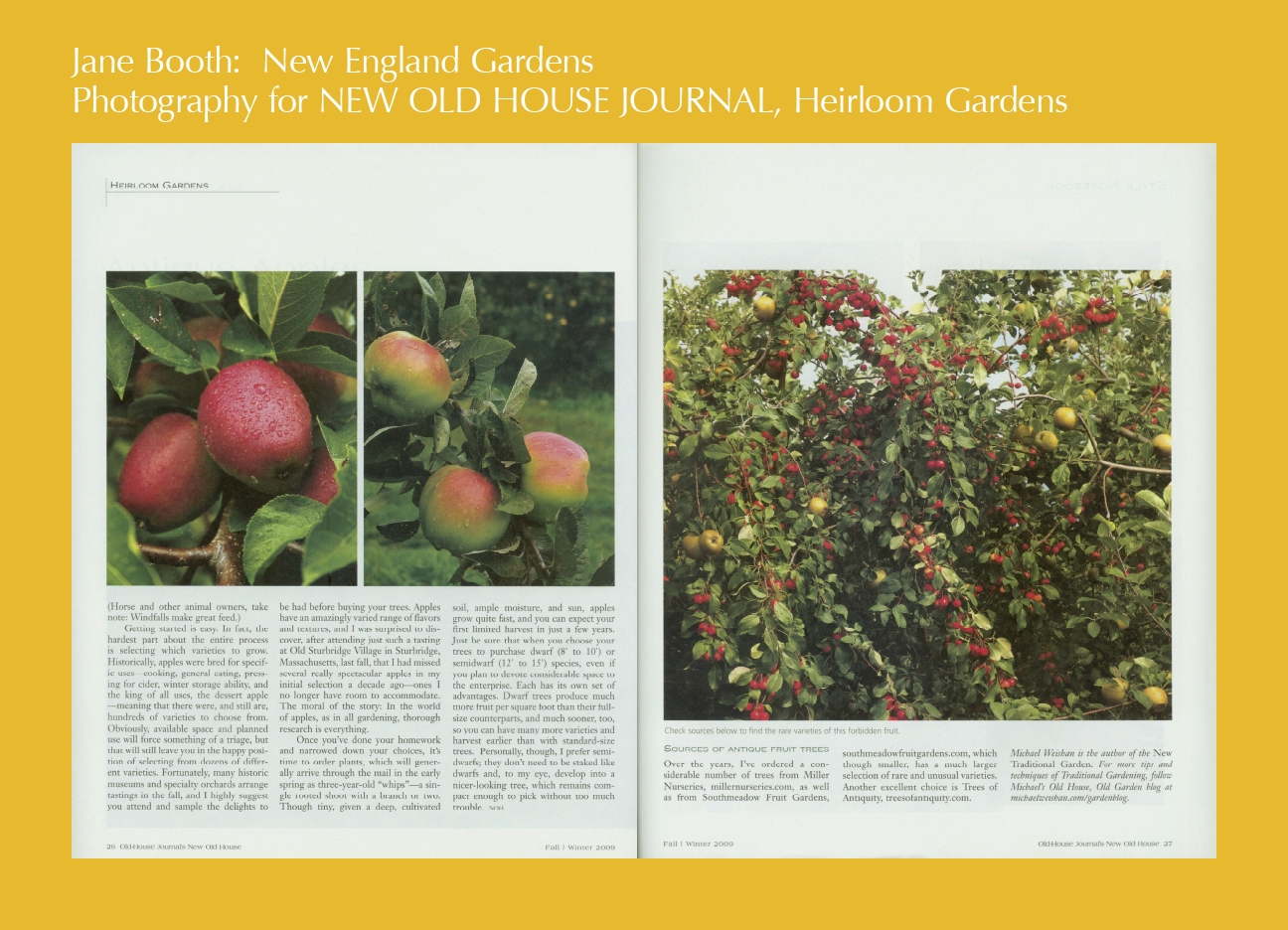
Bibliography – Heirloom Apples Our Favorite Books

Here are some of the titles we return to again and again to refresh our memories on fruits tart and sweet when we are lacking fruits to eat.

We are very careful with two collectible and historic guides to apples:

The Fruits and Fruit Trees of America; the culture, propagation, and management, in the garden and orchard, of fruit trees generally; with descriptions of all the finest varieties of fruit, native and foreign, cultivated in this country by A.J. Downing and corresponding member of the Royal Botanic Society of London; and of the horticultural societies of Berlin; the Low Countries; Massachusetts; Pennsylvania; Indiana; Cincinati, etc. – now that’s a mouthful!

The Apples of New York, Volumes I and II, S.A. Beach assisted by N.O. Booth and O.M. Taylor, Report of the New York Agricultural Experiment Station for the Year 1903.

More contemporary books are noted below.

Our two favorite sources are listed first.

The New Book of Apples by Joan Morgan, Alison Richards, and Elisabeth Dowle.  Their publisher, Ebury Press, calls it “the definitive guide to apples, including over 2,000 varieties.

When we can’t find what we are looking for in The New Book of Apples, we grab

Fruit, Berry and Nut Inventory edited by Kent Whealy and published by Seed Savers Exchange of Decorah, Iowa.  We have the third edition published in 2001 and know we need to upgrade soon.

Old Southern Apples by Creighton Lee Calhoun, Jr.  The revised and expanded edition is published by Chelsea Green.

Also by Chelsea Green, Michael Phillips The Apple Grower, A Guide for the Organic Orchardist.  We do not own a second book by Phillips, The Holistic Orchard:  Tree Fruits and Berries the Biological Way, but imagine it is just as good as the first.

A cute little book with great drawings and descriptions of heirloom apples is by Roger Yepsen and simply titled Apples. W.W. Norton & Company published this book in 1994 but it is still a treasure.

A new book on our desk is The Illustrated World Encyclopedia of Apples:  A comprehensive guide to over 400 varieties accompanied by 60 scrumptious recipes by Andrew Mikolajski and published by Lorenz books.

Apple of Your Pie:  A Collection of Apple Pie Recipes and the History of Apple Growing in America by Eileen Maher Kronauer and Charles Kronauer.  We found a copy of this interesting book of apples at a sweet little restaurant called Ariana’s in Orford, New Hampshire.

The Apple Source Book; particular uses for diverse apples by Sue Clifford and Angela King with Philippa Davenport, Common Ground

Another fun Common Ground book – Apple Games and Customs.

Orchards written by Claire Masset is great little book – we hope to have it and a sister book, Making Craft Cider,  put out by Shire Publications for sale at the farm stand.

 Apples; history, folklore, horticulture, and gastronomy by Peter Wynne, Hawthorn Books

Uncommon Fruits Worthy of Attention, A Gardeners Guide by Lee Reich, Addison Wesley Publishing Company

Grow Your Own Fruit, Carol Klein with Simon Akeroyd and Lucy Halsall, an imprint of Octopus Books/Mitchell Beazley

 Apple Pie; An American Story, John T. Edge, G.P. Putnam Son’s

 An Apple Harvest, recipes and orchard lore by Frank Browning and Sharon Silva, Ten Speed Press

The Origins of Fruit & Vegetables, Jonathan Roberts, Universe

 Apples by Frank Browning, North Point Press

The Fruit Hunters; A story of Nature, Adventure, Commerce and Obsession by Adam Leith Gollner, Scribner

The Apple Book, Rosanne Sanders, Philosophical Library,  New York in association with The Royal Horticultural Society

Apples, A Cookbook, Quantum Books Ltd

Pomologia from Netherlands/Germany/France/England by Johann Hermann Knoop, 1758 (reprinted FKG)

Burcombes, Queenies and Colloggetts by Virginia Spiers and illustrated by Mary Martin published by West Brendon

Gardener Cook by Christopher Lloyd, Willow Creek Press

 A is for Apple, Greg Patent and Dorothy Hinshaw Patent, Broadway Books

 Homegrown Fruit, Mimi Luebbermann, Chronicle Books

The Orchard, A Memoir by Adele Crockett Robertson – a truly wonderful book about tough times, Bantam

Henry David Thoreau, Wild Fruits, W.W. Norton and Company

 The American Apple Orchard, F.A. Waugh, 1911

 The Fruit Garden, A Treatise, P. Barry, 1862

Lipincott’s Farm Manuals – Productive Orcharding by Fred C. Sears, 1914

Please check our post on hard and sweet cider titles.

Please ask Jane Booth for permission to reproduce her copyrighted photographs and/or writing. Email jane.booth.1@gmail.com or call (802) 258-3971.   Jane has spent a good part of her career photographing and writing about gardens and small farms for Gardens Illustrated, Yankee Magazine, Country Living, Country Living Gardens, Better Homes & Gardens, New Old House Journal, and Cape Cod & Islands Home where she produced an ongoing column and feature stories.

 

Bibliography: Sweet and Hard Cider

We love the sweet heirloom apple cider we make at Landmark Trust USA’s Scott Farm.  The blend of apples changes with the ripening of our heirloom varieties at our orchard in Dummerston, Vermont.

We are lucky to have friend and fellow Vermonter, Jason McArthur, teach a hard cider workshop each fall at Scott Farm’s historic apple packing barn.  Contact Landmark Trust USA’s Scott Farm, kellyc@landmarktrustusa.org, for workshop dates for next fall and in the meantime we recommend you add cider books to your own library!

Making Craft Cider:  A Ciderist’s Guide put out by Shire Publications and written by Simon McKie

We have a signed copy of Cider, Hard and Sweet:  History, Traditions, and Making Your Own by Ben Watson published here in Vermont at Countryman Press.

Annie Proulx and Lew Nichols wrote Cider:  Making, Using, and Enjoying Sweet and Hard Cider.  Our third edition was published by Storey.

The American Cider Book, The Story of America’s Natural Beverage by Vrest Orton.  Our copy has been well thumbed and shows signs of age.

Please ask Jane Booth for permission to reproduce her copyrighted photographs and/or writing. Email jane.booth.1@gmail.com or call (802) 258-3971.   Jane has spent a good part of her career photographing and writing about gardens and small farms for Gardens Illustrated, Yankee Magazine, Country Living, Country Living Gardens, Better Homes & Gardens, New Old House Journal, and Cape Cod & Islands Home where she produced an ongoing column and feature stories.
 

Quince – A Versatile Fruit

While much of the orchard is planted with apples, one will find—beyond the rows of Baldwin, Orleans Reinette, and D’Arcy Spice—small, graceful quince trees with fuzzy-backed leaves. Quince, which is related to the apple and the pear has similar scent and flavor profile with overtones of guava and maybe  hints of pineapple depending on the variety.

Quince brighten the orchard

When fully ripened, quince may scent a room, and they are a treat to eat, whether poached, roasted, pureed or baked. But they are never ever eaten raw, as they have a hard, gritty, grainy, astringent flesh.

My husband, David Tansey, and I take frequent walks through the orchard, and from bud until harvest, we like to keep an eye on the development of the quince, delighting in the tightly furled, pink buds that untwist into crimson-veined, cup-shaped blossoms.

Tightly furled quince flowers

The flowers of edible quince are a beautiful sight in May 

The immature fruits are covered in a beige-pink, felt-like skin that turns green as the fruits size. By October the quince take on a sunny, golden yellow color, and whether the variety is pear-shaped or flattened and round, they brighten the orchard at midday and lend a glow in the early evening.

Quince (Cydonia oblonga), a native of Persia, have been cultivated for over 4,000 years. Searching for quince lore we read about paintings of Venus depicted holding this fruit of love and happiness in her right hand, and it is quite possible that it was quince and not apple that got Adam’s Eve into trouble.

Quince come in various shapes and sizes

Quince paste, so thick you can cut it with a knife, is a traditional food in the Mediterranean. The Portuguese call it marmelada, the Spanish membrillo, and in Sicily everyone gets into the act when quince are ripe to make cotognata. It is delicious with sharp or creamy cheeses, a treat on morning toast, or as a sweet end to a meal.

Richard “Lionel” Henry holding a bushel box of just picked quince

Below is a recipe for poached quince. But one of the easiest ways to prepare quince is to toss unpeeled, cored chunks of it into the roasting pan alongside freshly harvested carrots, chopped lovage, onion and a leg of lamb. We do the same when roasting a chicken, deglazing the pan with white white, or better yet, Calvados, to make a sublime juice to drizzle over the meat and vegetables. This year we will surely add quince to the preparation of our Christmas goose.

POACHED QUINCE

 2 medium quince

1/4 to 1 cup sugar, or to taste (sugar is needed to alter the astringency)

 Rub quince under running water to remove any fuzz. Cut in quarters or eighths, leaving skin and core intact (they add additional levels of flavor and pectin). Put in pot with water to cover, along with the sugar. Bring to boil then simmer slowly. The quince should be soft after 30 minutes and can be used as is, or add a tad more water if needed and poach them for two more hours; they will turn a pale pink, and if you have patience, simmer them a bit longer to coax them into a beautiful ruby hew. Cool the poached fruit, remove the seeds and core, and add pieces to an apple pie or Tarte Tatin, or serve on ice cream or yogurt. Don’t toss out the syrup, as the resulting elixir is good for the throat.

This story was originally published in one of our favorite magazines on Vermont food and farming, Local Banquet

Please ask Jane Booth for permission to reproduce her copyrighted photographs and/or writing. Email jane.booth.1@gmail.com or call (802) 866-3329.   Jane has spent a good part of her career photographing and writing about gardens and small farms for Gardens Illustrated, Yankee Magazine, Country Living, Country Living Gardens, Better Homes & Gardens, New Old House Journal, and Cape Cod & Islands Home where she produced an ongoing column and feature stories.  
David Tansey is the founder of The Landmark Trust USA and past president of Landmark and The Scott Farm, both located in Dummerston, Vermont.  He was involved in every step of revitalizing The Landmark Trust USA and Scott Farm properties.


Picking Dolgos

Cold hardy Dolgo crab apples originated in Kazakhstan and are a favorite early season treat.  We love to dry them for winter snacking and find them very appealing in salads – think tart sweet of dried cranberries.

August 8, 2012

The Dolgo crab apples began to color up a week ago.  By Monday they had turned into ruby jewels ornamenting the trees, two days later much of the fruit hanging on the outer upper branches are a deep, dark crimson.  Unlike their astringent crab apple cousins, Dolgos are edible — zesty, tart, a mouth full of sunshine.  We dehydrate them for winter snacking and as an addition to salads and granola — think dried cranberry.  They make a beautiful ruby jelly and when pressed they make a cider that looks and tastes like a pink lemonade treat.  Originating in Kazakhstan near the Siberian border, Dolgo means “long” in Russian alluding to their elongated shape.  Extremely cold hardy it is understandable why this antique crab apple was first imported in 1897 to South Dakota where winters are often unpleasantly frigid.

Richard and Michael, two of Scott Farm’s dedicated Jamaican crew, arrive in the farm truck with a warm wave and hearty hello. They have come to the orchard with their apple picking gear:  harvest buckets, bushel boxes, and wooden ladders polished from years of use.  There is a rustling of leaves as they set their ladders into the tree then a snap, snap, snap as they begin to pick, their fingers  working deftly — quick, exacting — both are gentle, their large man hands easing the olive-shaped fruit into harvest buckets held to their chests by a harness strapped across their backs allowing free hands for picking and ladder climbing.  At the base of their buckets hangs a canvas apron drawn shut with two short pieces of rope.  The harvest bucket, akin to a baby carrier, holds cargo almost as precious.  A short time passes, their buckets fill.  Neither Richard nor Michael bound down the ladders, instead they move slowly retreating to the ground.

Scott Farm, located in Dummerston, Vermont, is lucky to have dedicated Jamaican orchardists. Michael Johnson (on left) is Scott Farm’s fastest picker. Lionel “Richard” Henry (on right) is a trusted team leader.

Richard has set the wooden bushel boxes in the shade of the Dolgo crab to protect the just picked fruit from the strong summer sun.  Michael is first and hovers over one of the boxes.  Releasing the knotted stays from their keep, he slowly lowers the the circular canvas apron and its contents into the box.  Controlling the gravitational speed of the departing apples is an important step, if they travel too fast they will bruise not only from hitting the bottom of the box but from bumping neighboring apples.  It is an amazing sight to watch grown men so cautious and gentle with the fruit.

Picking Dolgo crab apples at Landmark Trust USA’s Scott Farm heirloom apple orchard in Dummerston, Vermont.

An hour and a half  passes, the tree is looking naked. We talk about respect.  Michael says adamantly, “You must respect the fruit, you don’t respect the fruit you bruise it, you bruise the fruit the buyer doesn’t want it, it is bad for the farm and bad for the worker who needs the wages.”  The young generation in Jamaica doesn’t understand hard work, nor do they want to do it.  We have the same problem in the states and worry about farm survival without a younger workforce.  Michael and Richard say there is pleasure gained from earning your keep and Richard notes “…a man that works hard is respected in the neighborhood, the man that is lazy is not.”

Picking heirloom apples such as the Dolgo crab, is a tedious and exacting art.

They continue picking, I inspect a neighboring tree filled with small, freckled yellow apples — Ananas Reinette.

Ananas Reinette, a heirloom apple from the Netherlands, is a small yellow apple with freckles and is one of our favorites.

Early in the season they remind me of limes, similar in shape in color.  Their expected harvest date is not long off and we are looking forward to tasting them — they have a sharp, juicy-sweet acidity.  Ananas means pineapple in French, textbooks note the Ananas originated in the Netherlands in the early 1800s.  I like eating this heirloom apple  with a couple of gooey slices of a good camembert, it is also good with feta cheese in a salad, is great sliced into yogurt, and recently I’ve been wondering if I could use them as a substitute in a pineapple upside down cake.

Ananas Reinette is delicious heirloom apple sliced into a salad with chunks of feta cheese.

I ask the guys if pineapples grow in Jamaica.  “Sure, sure,” they reply in their Jamaican lilt.  Richard tells me he grows them on his farm.  I’m not sure I’ve been aware all these years that Richard has his hands in the soil at home.  He tells me he grows sweet potatoes and corn.  His brother and a friend take care of this place when he comes north for Scott Farm‘s seasonal work.  I ask him what his soil is like and he says it is different, lots of clay.  They work the soil digging up the clay, baking clods of it in the sun, then break it up amending it with animal manures.

Both men have come to Vermont to utilize not only their orchard skills but also their attention to detail when packing apples for market.  They wake each day at 5:30 spending a bit of quiet time with a cup of tea.  By 7 a.m. they have left the farm’s apartment to open and stock the farm stand.  Depending on need they may spend the morning trimming out pervasive invasives from under apple trees.  When morning dew has burned off the fruit, they will pick the varieties that have reached the proper stage of ripeness.

Richard and Michael are nearly finished.  I watch their technique, two hands are necessary — one to hold the branch, the other to pluck.  Michael pinches the small apples between his fingers and gives a quick flick backwards collecting four, five, six Dolgo crab apples before dropping them gently into his bucket.  I never hear a thump, maybe a tiny bumping as he gently drops them in.

Michael Johnson uses two hands when picking Dolgo crab apples filling one hand with up to six heirloom apples while the other holds the branch steady.

Out of the 90 varieties of apples in the Scott Farm orchard, the Dolgos take the longest to pick.  Hewes Virginia Crab would be a close second. Thomas Jefferson grew Hewes at Monticello and used it to create a dry, highly flavored hard cider.

Hewes Virgina Crab, a heirloom apple loved by Thomas Jefferson.

Lady Apple, another mini apple, is one of the oldest varieties dating to early Roman days.  It is one of the best keepers at the farm.  The coolers where the fruit is stored are shut off the first of December when Scott Farm sells out most of the apples.  With luck there will be a half bin left of these cheery red and green apples with a white crisp flesh that becomes pleasantly aromatic in keeping.  Lady Apple is also know as the Christmas Apple.  With their cheery colors — red, green and a flash of yellow — they are a good choice for holiday decoration tucked in amongst cut boughs of pine and holly.

The Lady Apple or Christmas Apple is oldest heirloom apple variety grown in Vermont. Dating to early Roman days it is a great winter keeper.

It is nearing 3 p.m. and Richard and Michael are almost done.  They are both working in the shade on the north side of the tree. Covered head to toe with clothing they wear my husband David’s old winter boots designed for frigid Vermont winters, t-shirts topped with a long-sleeved shirts, long pants, and baseball caps to shield their eyes and protect their heads.  Richard is wearing a worn pair of David’s corduroys, I’m miserable in the heat and think it must be 90 degrees or warmer, a wretched persistent heat we have had for most of the summer is pushing the apples to ripen weeks ahead of schedule.  I ask the two how they can stand wearing all the clothes they have on and they tell me there is good reason for their madness.  They sweat, the clothes get damp, the damp keeps them cool although Richard laughs and admits,”Sometimes the boots do get too hot.”

At 3 p.m. they finish, in two hours they have picked 6.5 bushels of small, beautiful ruby red fruit from one tree.

Heirloom Dolgo crab apples fill a bushel box.

David Tansey is past President and CEO of The Landmark Trust USA and Scott Farm. He loves answering questions and sharing knowledge as he has been involved in every step of revitalizing The Landmark Trust USA and Scott Farm properties.  He may be reached at (802) 431-7111.

Please ask Jane Booth for permission to reproduce her copyrighted photographs and/or writing. Email jane.booth.1@gmail.com or call (802) 431-7111.   Jane has spent a good part of her career photographing and writing about gardens and small farms for Gardens Illustrated, Yankee Magazine, Country Living, Country Living Gardens, Better Homes & Gardens, New Old House Journal, and Cape Cod & Islands Home where she produced an ongoing column and feature stories.